All equalities are not created equal

DiagramSentence2

Diagramming sentences: “pretty” equals “predicate adjective.”

I love diagramming sentences.  When learning grammar, it’s a great alternative to the traditional way of labeling and describing parts of speech and sentence structure.  But the trouble with diagramming, as many in my life have been quick to point out, is that you can diagram a grammatically incorrect sentence.  And so for that reason, it is a flawed teaching tool.  I suppose.  Just because you put a slash in front of a word and call it an “adjective,” that does  not make it equal to an adjective.

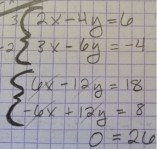
In my parallel-universe-math-class, we are learning how to solve linear equations, which means finding the point(s) at which various lines intersect on a graph.  The intersection is the solution.  If there is no intersection, there is no solution.  If you graph the lines, you can see there is no intersection.  But if you’re working with formulas to find the solution, you end up with an inequality–for example, “0 = 26”–that you then call “false.”  Everyone knows that 0 does not equal 26, and just because you put an equal sign in between two numbers does not make them equal.
20160412_085435

Solving a linear equation with substitution: “0” does not equal “26.”

I feel especially sensitive to this because this semester it has taken me (is still taking me) so long to understand how to solve equations, and I frequently end up with mathematical gibberish.  The assumption that I can look at “0 = 26” and “know” that it is false is, itself, flawed.

What do you do when you meet someone who doesn’t share the foundational knowledge that lets them know when something is or is not equal to something else?  And related, what do you do when that someone does not want to acknowledge that they have created a false equality?  And in these general terms, can we then go from diagramming –> to linear equations –> to hashtags and pithy memes?  How do you explain to someone that #BlackLivesMatter does not equal #AllLivesMatter, despite the structural similarity and the simple swapping of adjectives? How do you explain that gender neutral bathrooms do not equal the rape of your daughter? That religious freedom laws do not equal nondiscrimination laws?

Here’s where I end up:

  • In the grammar world, inequality can be a reason not to use a teaching tool, but this is because many grammarians acknowledge that not everyone recognizes inequalities when we see them.
  • In the math world, inequality can be just one of many outcomes, and it is a way to learn something about the problem at hand. “No solution” means something.
  • In the real world, how can we reconcile these two approaches when it comes to inequality in our communities?  There seems to be no (easy) solution.
 

3 is a 0 of multiplicity 2

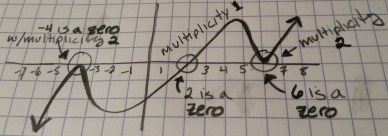
In a graph, when you touch or cross the x-axis, you can call that point “a zero.”  If whatever you’re drawing crosses the x-axis at “3,” then “3 is a 0.”  And “multiplicity” determines the shape of the thing you’re drawing at that point on the graph: the even numbers are parabolas, odds are dog-legs, and a “one” is a plain old line. “Multiplicity 2” means that at the point your thingy touches the x-axis, it does so in the shape of a parabola.  And although my class hasn’t gotten to this yet, I also know that it’s possible to have imaginary zeros.  I don’t know what you do with imaginary zeros.

multiplicity

Multiplicity has been a favorite word of mine since I was introduced to Bergson and Deleuze.  But I usually use the word in a sloppy way, as in: “we should have a multiplicity of voices represented in the literary canon.”  That’s a terrible thesis.  Bergson (who was a math whiz before he became a philosopher) wrote about both quantitative and qualitative multiplicities in much more precise, interesting ways.

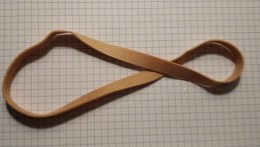
Qualitative multiplicity is found in a singular experience that can’t be juxtaposed against another one.  One of Bergson’s examples is to imagine the stretch and elasticity of an elastic band. “Bergson tells us first to contract the band to a mathematical point, which represents ‘the now’ of our experience. Then, draw it out to make a line growing progressively longer. He warns us not to focus on the line but on the action which traces it”(from the Stanford Encyclopedia of Philosophy).  The duration of the stretch, the inherent tension, the smooth transition from point to line, the experience of it all: these elements contribute to the qualitative value of the multiplicity more than a static image (such as a graph of a trajectory like the one above) can preserve.

20160327_215900So there’s math + philosophy. And also + art: in Findings on Elasticity, editors Hester Aardse and Astrid Alben write, “Elasticity has no inhibitions.  Science has no inhibitions…As science continues to shamelessly stretch knowledge as far as it will go, unburdened by inhibitions, so art, in its limitless ways of expressing human experience, often confronts our inhibitions and suggests where we should put them.”  It’s a wonderful book full of experiments and installations and inventions exploring (it seems to me) the question: How do we authentically record, document, preserve, share, communicate our experience of the qualitative multiplicity of elasticity?

These notions of multiplicity-via-elasticity (math, philosophy, art) relate to the nomadic paths of protest librarians and the (often surprisingly divergent) paths of the libraries’ physical collections of books.  The question is, how do these trajectories represent both quantitative and qualitative multiplicities, and how can they be recorded in a meaningful way.  This is a project to root around in over the summer.

PS: This article about an exhibit called “Design and the Elastic Mind” randomly passed through my Facebook feed just as I posted this entry: Curator Forced to Kill Out-of-Control Bio-Art Exhibit


Things are linearly sloping up.

In the 1970s, I drew buttons and flashing lights on a cardboard box, cut slots on each end, and called it a computer.  You could write a question on a card, drop it into the entry slot, and it would come out the other end with the answer to your query.  The catch (a doozy): I had to write the answer on the card before you dropped it into the computer, since nothing actually happened on the inside of the box.

In math class, we’ve reached the chapter on functions. Functions do the kinds of things I very much wanted to make happen inside my cardboard computer. They are all about inputs and outputs: f(x) = [something crazy like 3x + 2].  f(x) — which is a fancy way to say y — is dependent on the input of x.  If you input something as “x” and only one thing is output at the other end, then it’s a function and you can happily plot x and f(x)  on a graph.

The linear model that we learned about last fall in statistics is closely related to all of this (or so it seems to me).  The lineaLinearModelr model includes a slope (of a line), a y-intercept, and a relationship between dependent and independent variables.  They all work together to help predict the locations of dots on a regression analysis graph.  And I do love graphs.
 

https://scontent-ord1-1.xx.fbcdn.net/hphotos-xlt1/v/t1.0-0/p75x225/12806171_10204464689092278_808840399987044958_n.jpg?oh=21d7db807f885d7505a6662cadc11a7a&oe=575E66B0

This floated through my Facebook feed last week.  I can’t find a source for it.  But it makes about as much sense as linear models do when you don’t know algebra.

Understanding dependent and independent variables about killed me last semester, and they’re doing a number on me again.  But the cause/effect is clearer this time around.  My hat’s off to everyone who has to teach stats to someone like me, someone who doesn’t know what an algebraic function is.  I think this must have been the same kind of frustration as playing Mad Libs with someone who doesn’t know a noun from a verb from a postmodern platitude.

I feel triumphant in making this connection between functions and linear models (even if I still have some of it wrong).  And I am excited to think about how the spatial mapping of data (as dots) and relationships (as lines and slopes) is a much stronger undercurrent than I realized.  Maybe I should have known it.  But I didn’t.  But now I do.  So that’s progress, with the slope of my own linear progression again pointed upward and onward.

Confessionals, boy-crazy and otherwise

First:  I did not fail the test.  Nope.  Not a failure.  Not today.  Voice of reason: Although I am happy to have passed, it was a genuine surprise.  So clearly I have no idea how to self-assess my abilities in this course.  File that away as something to think about post-celebration.

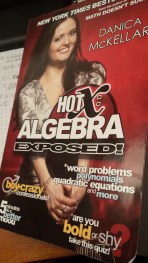
20160221_190638.jpg

Hot X: Algebra Exposed!  By Winnie from Wonder Years.

Second: I made progress on my black-hole tendencies.  I asked two questions in class, and I bought a new book.  Yes, this book.  Yes, the cover pumps a personality quiz and “boy-crazy confessionals.”  But Winnie-from-Wonder-Years’s tone is so much more likeable than my $400 course textbook.  The blurb promises that she “shows you how to ace algebra and soar to the top of your class–in style!”  The pep-talk to us girls (tween or otherwise) about being able to do math is a bonus.

Third: We started graphing things this week.  MY OPTIMISM IS RENEWED.  I love graphing.  I love graph paper.  I love charts and tables.  And grids.  It’s the whole reason I became a girl-scout as a kid: selling cookies meant I had control over the most magnificent, color-coded spreadsheet that a 1980’s 10-year old could hope for.  And when we planted a garden, we went the square-foot gardening route because it required a grid.  And crossword puzzles: a favorite pass-time.  So many tiny little boxes.  I use graph paper all the time, but using graph paper for its intended purpose brings a special kind of joy.

Finally: I’m not funny.  I know it.  Last week, a stranger commented that this blog was interesting but not funny.  Being interesting can be hard, so I’ll take that as a win and continue to forge ahead.  Onward and upward, everyone, mechanical pencils at the ready.  It’s a whole new week.

The negative wind speed beneath my wings

We had our first test this week.  The last question was a word problem about the amount of pollution in the air based on the speed of the wind.  Somehow, I ended up with a negative wind speed.  Which I know is illogical and impossible (unless I completely misunderstood the LIGO announcement this week).  But the math that I had worked out to arrive at the negative wind speed looked pretty much right to me.  And so, knowing that my answer was absolutely wrong, I wrote it down anyway.  Something is always better than nothing.

It is only this week dawning on me that I might actually fail this course, which has put me into a very fast five-stages-of-grief tailspin.  At the peak of my frustration, I told a friend that I was doing everything I knew how to do, and it wasn’t enough.  She said:

  • “Did you visit your professor during office hours?” No.
  • “Did you seek out tutoring?” No.
  • “Did you find other books to explain the same problem differently?” No.

She pointed out that I was not, in fact, doing everything I knew how to do.  Fellow math students have also suggested that I sit in the tutoring center while doing homework and that I ask around for links to YouTube videos of people working through the steps for given problems.

Honestly?  I HATE THESE IDEAS.  I believed learning math wouldn’t require as much collaboration as learning to write seems to require.  And honestly, the idea of doing math in a vacuum appeals to me. I’m not sure why, when I know how powerful collaboration can be.  For some reason, I want to be inside a black hole with math, where nothing IS something.  Or something like that.  Maybe my answer to this test question was me trying to tell myself as much.  Except I don’t know enough math to have ever orchestrated the negative wind speed answer on purpose.

This week, I need to reassess my goals with this math business.  If this project is going to last longer than a semester, I suppose I need a better plan.  Working in a black hole, as much as I like the idea of it, isn’t going to get me very far.

Quadratics and calligrams

screen-shot-2012-11-21-at-9-47-17-pm

The curve of the banana is a parabola that can be calculated with the quadratic formula.  More at http://blogs.swa-jkt.com/swa/10326/2012/11/21/quadratic-functions-in-the-real-world/

A month into the semester, and my algebra book has not yet mentioned this critical bit: the two solutions produced by a quadratic equation are actually the points on a graph that a parabola passes through.  Not until ch 3 this week, “Functions and Graphs,” when finally: we have some pictures.  This changes everything.

guillaume-apollinaire-la-tour-eiffel

A well-known calligram about the Eiffel Tower by Guillaumme Apollinaire. See more at http://www.galleryintell.com/artex/poems-peace-war-guillaume-apollinaire/

Coincidentally, this week my own students and I read the part of Foucault’s The Order of Things where he mentions “the beautiful calligrams dreamed of by Linnaeus” (135).  A calligram is a piece of text written in the shape of the object it describes.  It’s often associated with poetry, but it’s also tied by definition to pictures.

Botanist Carl Linnaeus attempted to use calligrams in his scientific descriptions of plants: “the order of the description, its division into paragraphs, and even its typographical modules, should reproduce the form of the plant itself.  That the printed text, in its variables of form, arrangement, and quantity, should have a vegetable structure” (135).  Linnaeus felt that his classification system would be better represented if he used the lines on the page as both text and image.  The idea of overlaying a mathematical, formulaic grid onto language in order to suss out buried meanings and connections is nothing new.  Centuries later Lacan would try something similar (in my mind, anyway) by creating mathemes: graphic representations of his ideas that you can now buy on tee-shirts.

ma-51791545-web

“The Treachery of Images,” Magritte  (http://collections.lacma.org/node/239578)

In a separate essay called “This is not a pipe,” Foucault discusses Magritte’s paradoxical painting as another type of calligram “secretly formed, and then carefully undone.”  He writes that calligrams “bring text and image as close as possible to each other,” and usually the calligram erases the binary between: “to show and to name; to figure and to speak; to reproduce and to articulate; to intimate and to signify; to look at and to read.”  In Magritte’s work, says Foucault, through the contradiction and the conflation of the words and image, this is an act of mischief.

The graph of a quadratic equation seems to be a mischievous  variation on the calligram, one that conflates the idea of general and specific, of a formula to be applied universally and of a specific diagram of a particular banana.  Seeing the equation and its result together simultaneously forms and undoes their relationship, at least for the uninitiated (as I am), at which point we are (I am) surprised and delighted to find the correspondence.

And a parting question for those who are already fluent in quadratics (can you say it that way?). I imagine that having both the equation and the graph is a bit redundant, the way Neo sees the Matrix code and the agents simultaneously, so once fluent, does the act of plotting the graph continue to generate any meaning, laughter, or surprise?

Please excuse my dear Aunt Sally: That’s an order.

We have begun working with quadratic equations.  I am failing this miserably, but I think I have discovered the root of the problem:  the Order of Operations.  This is the fundamental set of rules that dictates 5 + 6 x 2 equals 17 and not 22.  I realized last week that when overwhelmed by an equation, I start with the parts that look easy (so I do all the addition first, for example).  The Order of Operations says no, no, no, you can’t do it that way, and it makes my answers non-negotiably wrong.

20160201_204717.jpg

Please Excuse My Dear Aunt Sally: Parenthesis, Exponents, Multiplication, Division, Addition, Subtraction.

Until today, I believed that basic math skills were grounded in axioms (self-evident propositions) and theorems (things capable of being proved).  But in studying up on the Order of Operations, I found that it is a convention.  Granted, it’s a widely accepted, super duper important one.  But at its heart, a convention is simply “an agreement or covenant between parties.”  In other words, I’m failing math because of a spit and a handshake.

If a convention is simply an ongoing agreement to a set of (arbitrary) rules, then the Order of Operations is just math’s grammar, a study of “the relations of words in the sentence, and with the rules for employing these in accordance with established usage.”  My field of writing and composition has largely abandoned the right/wrong binary of grammar in favor of multiple grammars representing marginalized voices.  My biased impression is that basic math has, conversely, tightened its grip on this binary.*

Math and writing used to have multiplicity more in common.  In Hidden Harmonies: The Lives and Times of the Pythagorean Theorem, I read that Babylonian scribes may have “thought of values differently arrived at the way we think of variant spellings: there is no ideal that ‘color’ or ‘colour’ better realizes” (36).  And the authors then write that the algebraic Babylonian culture “was founded on recipes, which are always modified by locality and detail” (41).

I have to tell you, I love the idea that my test answer isn’t wrong–it is simply my shiraz to math’s syrah.  Come on, Aunt Sally. Let’s carve out a little space for my particular dialect of quadratic equation.  We can discuss further over a glass of wine.

*This might be because so much of the homework is done online with inflexible, automated grading systems.  The computer is a harsh mistress.

Radicals in math and politics

Chapter one of College Algebra: we are learning about square roots. After you square something, you can use a square root to undo the square.  They provide reversibility.  The number under the root-sign-thingy is the radicand, and the number on the outside is the index. The entire square root expression is called a radical.

20160124_114242

Radical power: defining degrees of freedom (in stats)

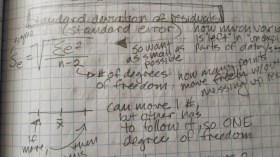
Radicals seem to be mostly used for party tricks with negative numbers. “Hey, Pythagoras, watch me square this negative number. POOF. I have a positive number. Where did the negatives go??” Without the negative, you can do practical things like calculate a standard deviation and play with “degrees of freedom.” As long as the squared numbers remain under the safe cover of the radical, they are in a (heterotopic) space where you can add, divide, apply, and make meaning.  And the really wondrous part? Not only can you square away negative signs when you don’t want them, and not only can you later conjure them back with your radical-at-the-ready, but you can ALSO bring them back with the new meanings still attached.

20160123_231735

Correlating radical math with radical politics

A radical in math is related etymologically to a radical in politics. The word means “from the roots, fundamental,” and—most surprising to me—”vital,” as in: “the humour or moisture once thought to be present in all living organisms as a necessary condition of their vitality.”  Thus a radical math expression and radical politics both desire to get at the root of a thing, to dig down to the fundamental part that cannot be broken down into anything smaller, to understand the vitality permeating the matter.  Imagining radical activists (think Arab Spring or Occupy) camping under the umbrella of the radical sign, it’s only a small step then to disappearing the negatives, functioning from a place of absolute value, and harnessing the inherent vitality of their expression. The power of this expression comes from the quantity of the root, which increases exponentially.

I’m not sure of the value in this comparison, other than to say there it is.  In my studies of radical politics, I plan to think more about the disappearing negatives, degrees of freedom, and how meaning is carried back across the threshold of the radical.

I’m a math major.

Last semester, I took a statistics class with the excuse that it was job-related.  The truth is, though, deep down I have always been in love with math and ashamed to admit it.  In high school and college, when one is required to make life-long decisions before one really knows what life-long should and could be, I chose the English direction rather than math.  I believed (wrongly) that this was an either/or choice.

But statistics opened a fissure.  Math is everywhere: Borges is all about math.  Badiou is all about math.  Libraries are all about math.  And that’s just the easy-to-list stuff.  So this semester, I formally declared myself a math major at the school where I teach, and I have enrolled in College Algebra.  This is my first math class since 1987*. I have to take another basic skills class after this, then four semesters of calculus, and THEN I can start the “real” math major classes.

I should have probably started with an even more elementary class, but my ego (and checkbook) didn’t want me to.  So only in week two, I am already struggling to keep up.  I am a terrible student.  This is going to be a long journey.

Someone suggested that I blog about it.  I don’t know who will want to read this, how often this topic has been done, or even what I will have to say.  But I think it’s a good idea.  I make my students blog and “reflect.”  So a little practicing of the preaching is in order.  Who knows what this might add up to (<- see what I did there?).

*Except for stats last semester, and a little foray into developmental math a few years ago.