Unknown's avatar

About sherrinf

Researching libraries, book culture, & writing processes.

Bans, Challenges, Curation, & Trash: When private interests dictate public resources

This project examines the repercussions of physical book bans leading to trashed books. What happens when books are trashed? Where do they go? Into whose hands might they fall? Is it possible that an approach of increasing bans—rather than “challenges,” “curation,” or “quarantines”—might have the effect of wider dissemination, less institutional control, and easier access to the banned texts?

The number of books being challenged at school libraries and public libraries has been growing. In 2024, there were 821 censorship attempts targeting over 4,000 titles. The majority of these title are about queer people or people of color

72% of censorship attempts in 2024 were initiated by pressure groups and decision makers who have been swayed by them rather than individual parents with specific concerns about single books. 

Moms for Liberty is one of these pressure groups. Their version of modern American book banning is a change in language from “book banning” to “book challenging,” and then from challenging to “quarantining” or even “curation.” They don’t want books removed from the shelf, just put on a higher shelf. They want to require patrons to ask for it. To require parents to say in writing that they “opt in” so that their children can read a wider variety of books, books that may help them grapple with aspects of their lives that some adults don’t seem to want to admit exist.

As patterns around the challenged books come into view, the message is clear that these groups take issue with certain lifestyles and identities.The ALA reports, “Titles representing the voices and lived experiences of LGBTQIA+ and BIPOC individuals made up 47 percent of those targeted in censorship attempts.” The pattern reveals a clash between a larger societal value of embracing people as they are vs a narrow set of family values that claim children need to be sheltered from people different than ourselves. It says to those who are different, you are wrong. You require permission to interact with.You need to be curated.

The BookLooks approach feels like Foucault’s description of Catholic confession in the History of Sexuality, the idea that sex is more easily controlled if we turn it into discourse rather than banning it. A discursive approach fetishizes saying everything out loud, zooming in on it, examining every crease and fold and turn of phrase until it ceases to be anything sexual, reflective, or personal, and instead becomes a litany of items to be checked off of a list, the chaos and rage and energy of exploring one’s emerging sexuality and identity now relegated to single lines on a google spreadsheet.

A ban, on the other hand, allows something to flourish in the dark, out of sight, as decent society looks away. While a quarantined book remains within the purview of a regulatory institution, a banned book would be released from institutional oversight. Should a banned book find itself remaindered, literally tossed into the garbage, that would be an undesirable context but one that paradoxically increases a book’s public accessibility.

In Italo Calvino’s short essay, “La Poubelle Agréée,” (“The Agreeable Trashcan,”) he ruminates on the dividing line between public and private trash, that moment during the ritual of taking out the trash, that the detritus and excesses I generate in my own home are handed over to the city to properly dispose of. It is a pact between us, and taking out the trash is a kind of a civic duty. It is “the last gesture of ceremonial upon which the private is founded.”

He says that “the gesture of throwing away is the first and indispensable condition of being, since one is what one does not throw away, then the most important physiological and mental gesture is that of separating the part of me that remains from the part I must jettison to sink away into a beyond from which there is no return.”

“Writing,” Calvino continues, “no less than throwing things away, involves dispossession, involves pushing away from myself a heap of crumpled-up paper and a pile of paper written all over, neither of the two being any longer mine, but deposited, expelled…”

Librarians have practiced mediation before. At the turn of the 20th century, a short blurb in an Oakland, CA newspaper reports librarians removing the comics sections from newspapers, and other documents record librarians’ resistance to offering novels and “easy reading” to the general public. The Dewey Decimal System is notoriously problematic, originally classifying “homosexuality” as a disorder, and assigning other keywords like lesbian, gay, bisexual, transgender and intersex to categories such as Abnormal Psychology, Perversion, Derangement, Social Problem and Medical Disorders.

Moms for LIberty spawned another group, Booklooks.info, which offers a “playbook” for challenging books. They have a 7 step plan of action which culminates with voting out board members who do not respond to every challenge they bring.

The BookLooks approach applies a rating to a list of ready-made “book reports.” Each report includes a detailed list of references and quotes, each tagged with codes for various offending characteristics. The BookLooks approach is a sophomoric approach of quote mining to try to make one’s point.

Meanwhile, the ALA created United Against Book Bans in response, and they offer a rsumé for each book. The resumés offer a bigger picture, putting the book into the context of critical reviews, accolades, and the author’s identity.

But all of this–from both groups, the reports and the résumés–is freely available on the internet, so now any young person with a phone can read all the reasons why they should be able to read the book on one site, and on another site read the book’s most salacious content distilled into a list on a page that meekly says, “If you’re under 18, look away.”

The philosophical question of what it means to put something in the trash is to ask where the public and private converge and cross over, and it is to ask how our detritus defines who we are. When that something is a book, then looking at libraries whose collections of books are books literally pulled from the garbage may prove insightful.

One library with a collection pulled from the garbage is in Ankara, Turkey, the Norm Altaş İşçi Kütüphanesi (“Worker Library”), which holds a collection of more than 6,000 books collected by sanitation workers along their garbage routes since January of 2019. The library is housed in an empty building donated by the sanitation department and the municipality pays for a full-time librarian.

A second is in Bogota, Colombia, where trash collector Jose Alberto Gutierrez began building a library in his own home with books pulled from his route. Twenty-five years later, and with 25,000 books, he runs La Fuerza de las Palabras (“The Force of Words”), and his library is open to the public, regularly used by many of the children in his local neighborhood.

And the third is the Yiddish Book Center in Amherst, MA. In the 1980’s, Aaron Lansky rescued thousands of Yiddish books from the garbage, almost single handedly revitalizing the Yiddish language and culture.

One way to make the trashing of books more palatable is to think of such a library as a genizah. Genizot were places where in the Middle Ages Jews disposed of holy writings that were damaged or no longer relevant. Alberto Manguel says that the genizahs became “involuntary archives.” These genizot, as archives comprised of trashed or banned documents, shed unique light on the culture or community doing the trashing.

In the context of this America, in order for books to be truly free to the public, is it fair to say that they need to be thrown away? I am uncomfortable with this claim. But maybe we should not navigate around it but instead speed straight into it. Blow it up. Break the system by leaning into it so hard it falls apart.

Grounded upon these three libraries and the Cairo Genizah, we need to think through the repercussions of physical book curation rather than bans leading to trashed books. What happens when books are trashed? Where do they go? Into whose hands might they fall? Is it possible that a radical approach of increasing bans—rather than “quarantines”—might have the effect of less control, wider dissemination, and easier access to the banned texts?

This seems to be what Moms for Liberty are trying to do with library boards. How do we counter this? How do we counter it without breaking libraries? Perhaps we can apply this approach to the Moms for LIberty and BookLooks groups. They ask concerned parents to submit books to be read. Let’s submit some books. 

ALA’s top 10 most challenged books in 2024: 1. All Boys Aren’t Blue, by George M. Johnson 2. Gender Queer, by Maia Kobabe 3. (TIE) The Bluest Eye, by Toni Morrison 3. (TIE) The Perks of Being a Wallflower, by Stephen Chbosky 5. Tricks, by Ellen Hopkins 6. (TIE) Looking for Alaska, by John Green 6. (TIE) Me and Earl and the Dying Girl, by Jesse Andrews 8. (TIE) Crank, by Ellen Hopkins 8. (TIE) Sold, by Patricia McCormick 10. Flamer, by Mike Curato
Braun Fellowship: “Public Literacy, Outsider Libraries, and the Concept of the Remainder”

I learned recently that I have received the Braun Fellowship, a three-year award with funding to support research expenses including equipment, travel, and professional services. It is an honor to have been selected, and I’m thrilled to have funding for “Public Literacy, Outsider Libraries, and the Concept of the Remainder,” or what I have been casually calling “trash library research.” Trash libraries, and more generally libraries with collections comprised only of leftovers, discards, waste, and “remainders,” emerged as a thread during my research on protest libraries and now (happily) I am able to turn my attention to it fully. Sincere gratitude to Saginaw Valley State University, the Saginaw Community Foundation, and the Harvey Randall Wickes Foundation.

Wrapping up Writing Machines

I just finished up a semester teaching an online 200-level writing course called “Writing Machines” for the first time. I developed it as 100% online and asynchronous, so we were not affected by any covid-related social distancing policies. But the stress levels, fatigue, and multitude of external events pulling on our collective attention affected my students and me as much as any face-to-face class. The exhaustion I feel, and that my colleagues and students have shared that they’re feeling too, differs from the usual end-of-semester exhaustion. And not in a good way.

Despite these hurdles, I feel like the class was a success.  I had several goals in mind as I developed the new content, some of which I met more effectively than others. In the spirit of reflection and writing in public view (the same wringer my students have to go through), I’ll share them here.

Goal #1: Do not require any book purchases. The cost of textbooks in many general education courses is way too high, and our campus encourages faculty to consider OER materials. But sometimes you need a very specific text for a specific reason: it’s about the author, context, style, and argument more than just the information conveyed. Fortunately, our campus library has many of the books and articles I wanted to assign, so by using e-books through our library and a few articles posted freely online, I was able to create (what I believe to be) an amazing reading list of relevant articles and chapters written or edited by rhet/comp experts. Eliminating book costs as a barrier to completing the course was an unqualified success.

Goal #2: Focus on diversity in the reading list. Amplifying the work of missing or marginalized voices in one’s field is more important than ever, and I feel good that our final reading list includes professional writers who identify as women, Native American, Black, Latinex, LGBTQIA, and as members of the disability community. Goal #2 was difficult, in large part because of Goal #1. There were many texts written by a wonderfully diverse group of professionals that would have cost too much money. Finding a better balance is something I will focus on in future semesters. [Students, I challenge you to review your course reading lists next semester and consider what kinds of writers are included and excluded, and then consider why that might be the case.]

Goal #3: Incorporate hands-on, non-digital activities. A course emphasizing the materiality of writing, taught in an online format, relying solely on digital texts sounds like an oxymoron. Is it possible to describe online the differences among papyrus, linen, and bark papers? Yes. Could I post pictures of the 18th century pages with heavy typesetting embossing? Yes.  Would this be anything like holding, sniffing, folding, and writing on those papers yourself? Not. At. All.  So I mailed out packets of supplies, and then we wrote a series of blog posts, each of which required some kind of experiment or project and reflection. In addition to the tactile aspects, I also wanted students to do some of our classwork away from the computer because we were all suffering some degree of “zoom fatigue.” AND I wanted to give them a reason to practice their own writing style and voice through public writing. I think most of the students really enjoyed this part of the class. I know I did.

Goal #4: Make explicit connections to Writing Studies pedagogy, and specifically to Writing About Writing. About 50% of our ENGL 111 classes in the fall used this textbook (our First-Year Writing program has not adopted an OER textbook), and I wanted to reinforce some vocabulary and concepts for those students. For other students, I wanted to introduce the concepts. The book was not a required purchase. I used a series of assignments from the textbook, modified for our particular course content. I think it worked pretty well and served as a springboard into some amazing student papers. 

I have some revision and development to complete before I teach this again next year based on student feedback and my own lagging to-do list.  While a couple of students have expressed dissatisfaction or frustration, it does seem that most of them had at least a good experience, if not an outright enjoyable one.  In their final blog reflections (you can read a couple here, here, and here) a great many of them explained how their relationship with writing had changed for the better and how their own identity as a writer had become better developed.

You can read more about the course here. If you want to talk about this class, about “writing machines,” or about the materiality of writing, let me know!  I would love to have a conversation.

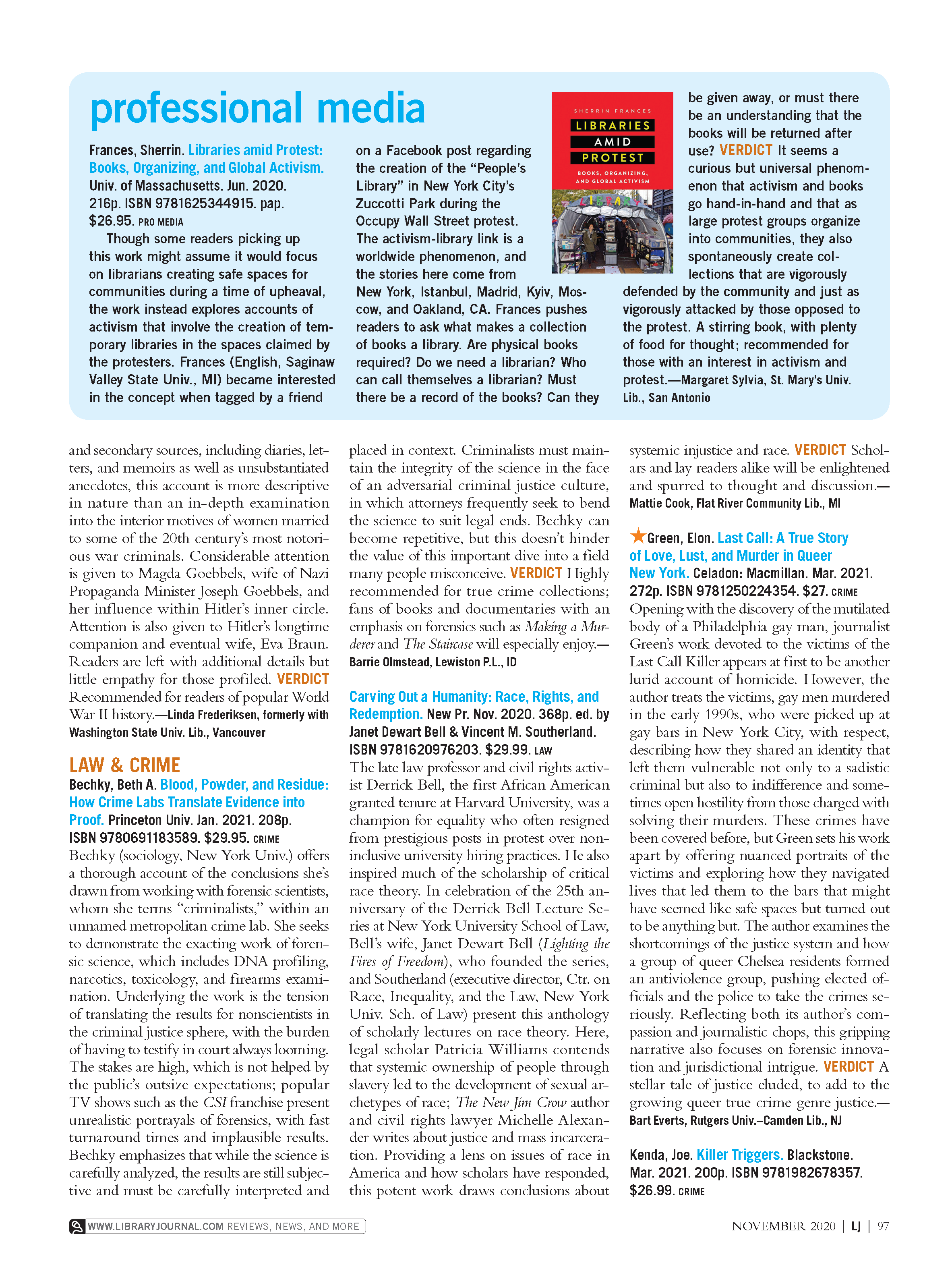
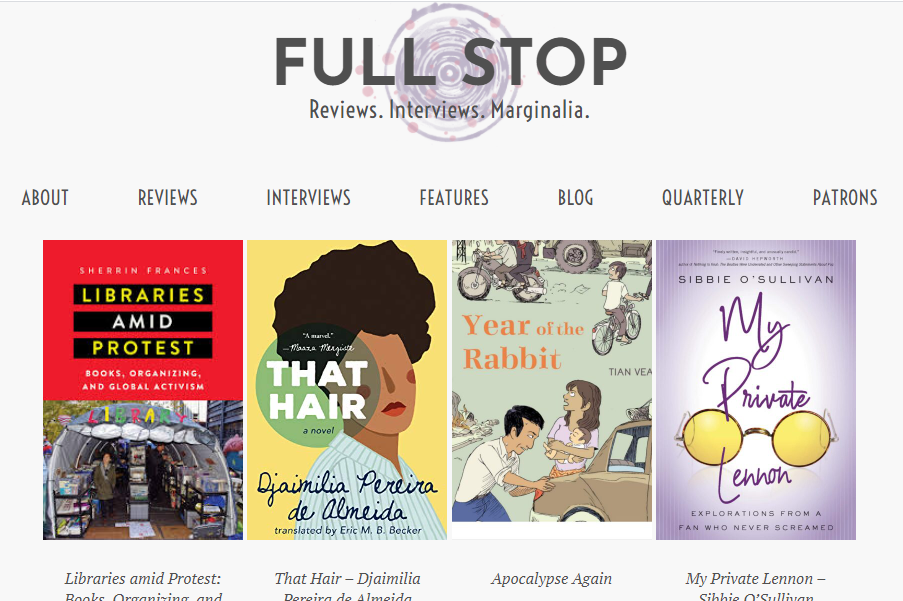
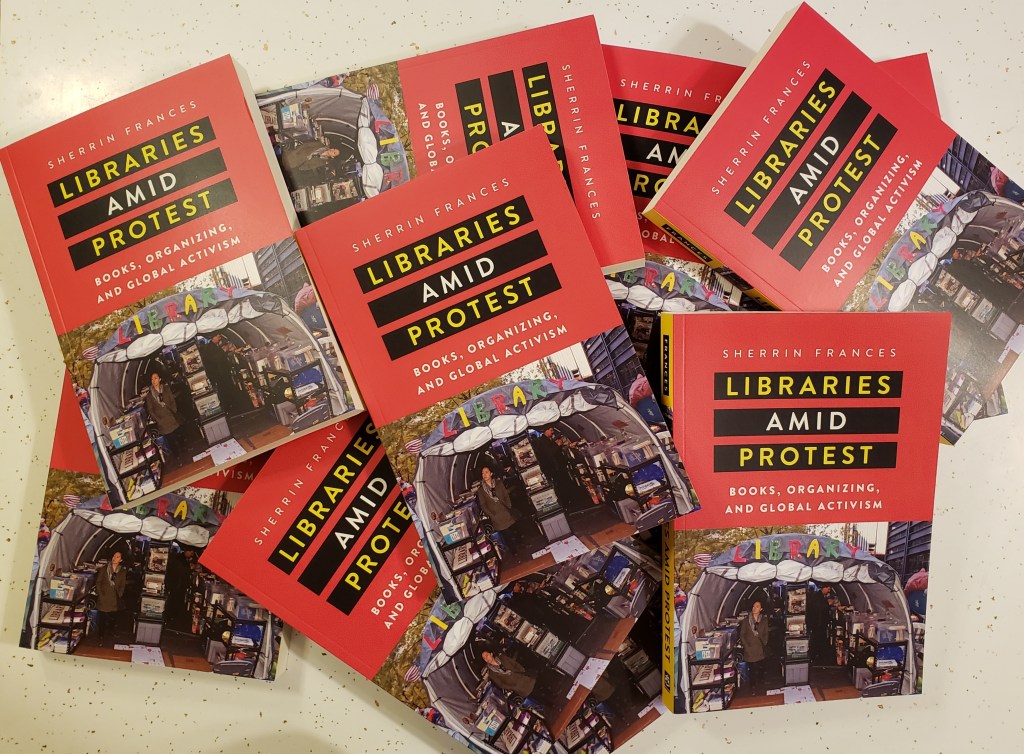
First reviews for Libraries amid Protest

Today, the first two reviews of the book crossed my social media feed. I am elated that these reviewers took the time to read the book and to write so thoughtfully about it.

From Cherilyn Elston in Full Stop: “What is original about LIBRARIES AMID PROTEST is Frances’ decision to foreground the library not as a distraction from the “real work” of the occupation but as a key component of its politics.” https://www.full-stop.net/2020/11/06/reviews/cherilyn-elston/libraries-amid-protest-books-organizing-and-global-activism-sherrin-frances/

From Margaret Sylvia in Library Journal: “A stirring book, with plenty of food for thought; recommended for those with an interest in activism and protest.” https://store.emags.com/libraryjournal_free (Nov 2020, p.97)
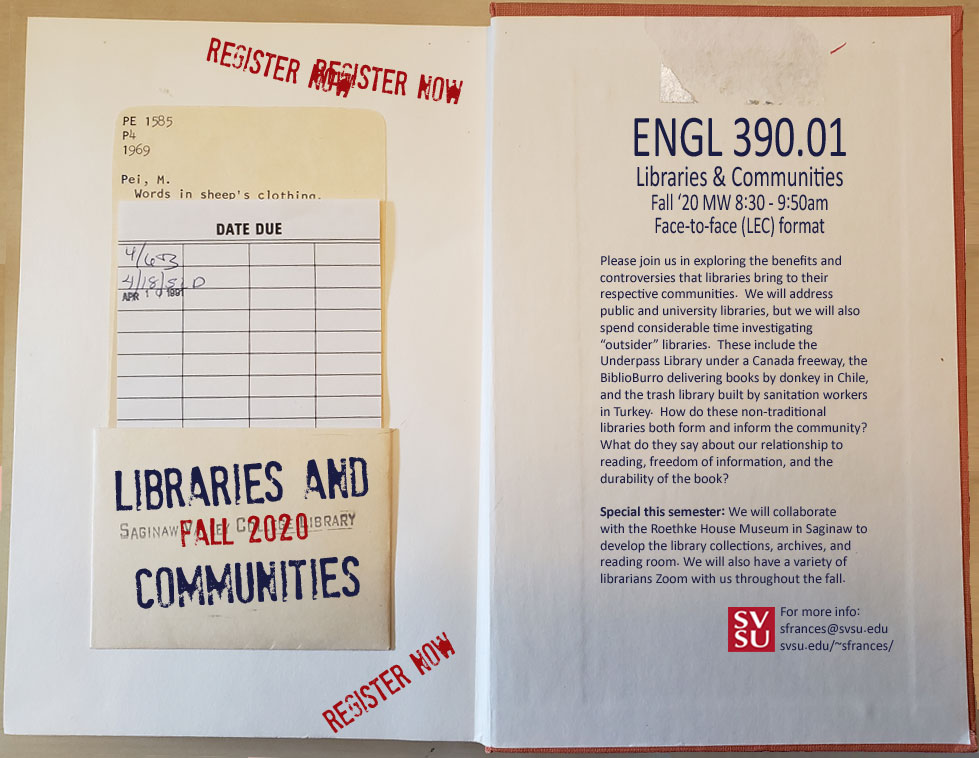
New class! ENGL 390.01, Libraries & Communities*

ENGL 390 promotional graphic. Image text repeated below.

Please join us in exploring the benefits and controversies that libraries bring to their respective communities. We will address public and university libraries, but we will also spend considerable time investigating “outsider” libraries. These include the Underpass Library under a Canada freeway, the BiblioBurro delivering books by donkey in Chile, and the trash library built by sanitation workers in Turkey. How do these non-traditional libraries both form and inform the community? What do they say about our relationship to reading, freedom of information, and the durability of the book?

Special for Fall ’20: We will partner with Saginaw’s Roethke House Museum library for some hands-on experience, and we will also Zoom with a variety of librarians throughout the fall. This will be a small class, so we will meet twice weekly in a traditional face-to-face (LEC) format. I am VERY excited about the opportunities we have this fall.

If you are interested but want more detail, or if you want to make any suggestions as to the content we cover, please email me at sfrances@svsu.edu. I will be finalizing the syllabus in a few weeks.

*ENGL 390 is a special topics class, so technically this is a new topic and not a new class. But it is the first time that this topic has ever been offered.

Counting the days: Zero hour.

Several years ago I began a blog to document my pursuit of a math degree. I was sidetracked by other things more closely job-related (I wrote a book about libraries, among other things.) It has been three-ish years since I took my last math class. That pursuit, though not abandoned, has been tabled indefinitely. I’m renaming this site to something more generally professional where I can post things related to more than math. Although when math returns, this is where you’ll see it. This little note to for the few of you connected to this site, and serves as the milestone marker between what began here and what lives here now.

Calculus: Formula for inspiration

I started Calculus I this fall.  We’re six weeks into the semester, and I just passed my first test (a surprise, considering I could only remember one formula so I used it on every single problem).  I haven’t posted since the end of last semester because, honestly, I just wasn’t sure until today that I was going to keep going with this math shenanigan.  This is a huge expenditure of time and, despite my enthusiasm, it still does not come naturally.  And there are so many things going on.

But this morning a girlfriend told me today that I had inspired a mutual friend to take a class next semester.  This made me happy to hear.  I was flattered.  My ego got a little bigger.  My guess is, though, that this mutual friend would probably have taken the class anyway, because he’s that kind of person.

Then this afternoon, I ran into a math classmate on campus and we had a brief exchange about the class–she is struggling, too, but has to complete this class in order to get into grad school.  And she inspired me, even though I’m (obviously) already taking the class.  Inspiration is a funny thing.

Hebetude, and other words I learned this spring

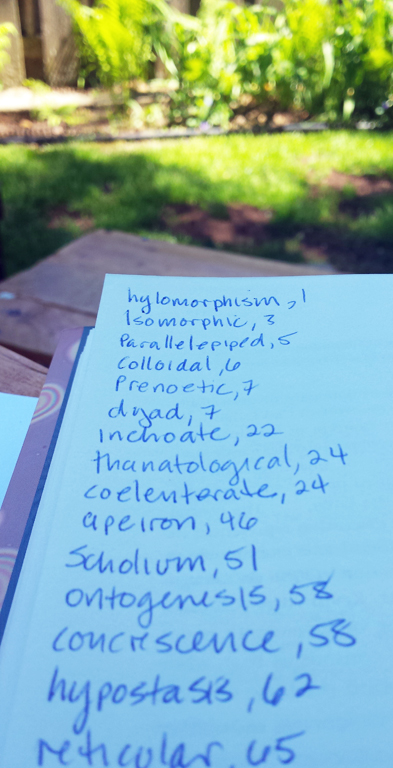
WordListI’ve had some glorious downtime recently and managed to read Combes, Finn, and Ronell.  I looked up all the words I had never seen before, the words I could only make educated guesses about, and the words I wanted to confirm based on context.  It’s what I tell my students to do, but it had been a long time since I’ve done it myself.  Tedious but fruitful. Also, I’m a little gratified that, of the 37 words, spellcheck claimed 12 did not exist.  Here’s my list, which includes the authors’ original sentences.

Anodyne: “Many poems seem to respond to their prompts with the same flat, affectless tone as the Mechanical Turk system itself, offering up anodyne confections of cliché and truism, completing the task of composition in as little as twelve seconds” (Finn 140).

Apeiron: “With this reference to nature, Simondon places himself in a pre-Socratic lineage, which is asserted explicitly in his definition of nature as ‘reality of the possible, in the form of this apeiron from which Anaximander generates all individuated forms.’“ (Combes 46).

Apophenia: “One of the most compelling aspects of games is precisely the seduction of algorithmically ordered universes–spaces where our apophenia can be deeply indulged, where every event and process operates according to a rule set” (Finn 123).

Arbitrage: “These companies are engaged in a form of algorithmic arbitrage, handling the messy details for us and becoming middlemen in every transaction” (Finn 97).

Autopoiesis: “This line of argument evolved into the theory of autopoiesis proposed by philosophers Humberto Maturana and Francisco Varela in the 1970s, the second wave of cybernetics which adapted the pattern-preservation of homeostasis more fully into the context of biological systems” (Finn 28).

Avuncular: “He leaps over the diegetic boundary of the story to touch us in a way that manages to be both avuncular and calculating” (Finn 107).

Badinage: “Algorithmic platforms now shape effectively all cultural production, from authors engaging in obligatory Twitter badinage to promote their new books to the sophisticated systems recommending new products to us” (Finn 53).

Catachrestic: “The point to be considered here, though, is that God needs the catachrestic maneuver in order to love” (Ronell 54).

Chiaroscuro: “The images show the data points of cars and office lights, buildings and structures, weather and movement patterns in long, unmoving chiaroscuro shots” (Finn 105).

Coelenterate: “Although the example of coelenterates on which Simondon bases his description of the individuation of living beings may appear surprising, or even poorly chosen in light of the difficulty in this case of precisely determining the site of individuality, it does not seem to me that the author made this choice lightly” (Combes 24).

Colloidal: “The clay can eventually be transformed into bricks because it possesses colloidal properties that render it capable of conducting a deforming energy while maintaining the coherence of molecular chains, because it is in a sense ‘already in form’ in the swampy earth” (Combes 6).

Concrescence: “Insofar as any technical individual is a system of elements organized to function together and characterized by its tendency toward concretization, we must distance ourselves from human intentionality and enter into the concrescence of technical systems in order to understand the mode of existence of technical objects” (Combes 58).

Consilient: “The spare utility of the search bar or the interfaces for Gmail, YouTube, and other essential services mask a deep infrastructure designed, ultimately, to construct a consilient model of the informational universe.                (Finn 66).

Diegetic: “Like other elements of the diegetic background of the show, the Enterprise’s talking computer was meant to be unremarkable and efficient” (Finn 67).

Dyad: “To begin with the operation of individuation is to place oneself at the level of the polarization of a preindividual dyad (formed by an energetic condition and a structural seed)” (Combes, 7).

Elide: “Algorithmic systems and computational models elide away crucial aspects of complex systems with various abstracting gestures, and the things they leave behind reside uneasily in limbo, known and unknown, understood and forgotten at the same time” (Finn 51).

Farragoes: “We tell collective jokes and stories using comment threads and hashtags, building shared narratives and farragoes that can evolve into sophisticated techincal beings in their own right as Internet memes as superficial as #lolcats or as potent as #blacklivesmatter” (Finn 193).

Fiat: “The blockchain relies on a computational fiat by rewarding the miners who bring the most computational power to bear on calculating each new block” (Finn 166).

Fungible: “If software is a metaphor for metaphors, the algorithm becomes the mechanism of translation: “the prism or instrument by which the eternally fungible space of effective computability is focalized and instantiated in a particular program, interface, or user experience” (Finn 35).

Hebetude: “Back at his desk from the Orient, Flaubert famously bounces Charles Bovary’s hopeless hebetude against his wife’s destructive jouissance; the life span of the nonstupid, frustrated and shortened, considerably fades, whereas the dumbest, including the calculating pharmacist, survive” (Ronell 38).

Homeostasis: “Central to this upper ascent is the notion of homeostasis, or the way that a system responds to feedback to preserve its core patterns and identity” (Finn 28).

Hylomorphism: “In this respect, the philosophical tradition boils down to two tendencies, both of which are blind to the reality of being before all individuation: atomism and hylomorphism” (Combes 1).

Hypostasis: “Could we not avoid this hypostasis of a ‘sense of becoming’ wherein normativity culminates in the notion of ‘error against becoming’?” (Combes 62).

Imbrication: “Google’s near omni-presence online, its imbrication in countless cultural systems that do not merely enable but effectively define certain cultural fields of play for billions of people, make this more than just a suggestion service or even a sophisticated form of advertising” (Finn 74).

Inchoate: “Thus the animal appears to the observer of individuation as ‘an inchoate plant,’ that is, as a plant that was dilated at the very beginning of its becoming;” (Combes 22).

Isomorphic: “Thus, in super-cooled water” (i.e., water remaining liquid at a temperature below its freezing point), the least impurity with a structure isomorphic to that of ice plays the role of a seed for crystallization and suffices to turn the water to ice” (Combes 3).

Littoral: “Part of the work of the Netflix culture machine is to continually course-correct between that narrow aesthetic littoral and the vast ocean of abstraction behind it” (Finn 108).

Ontogenesis: “As is always the case with Simondon, philosophy will remain a philosophy of individuation, an ontogenesis” (Combes 58).

Parallelepipedic: “Now, the clay matter and the parallelepipedic form of the mold are only endpoints of two technological half-trajectories, of two half-chains that, upon being joined, make for the individuation of the clay brick” (Combes 5).

Predation: “The heroes of Lewis’s story are those trying to eliminate the ‘unfair’ predation of HFT algorightsm and create an equal playing field for the trading of securities as they imagine such things ought to be traded” (Finn 153).

Prenoetic: “The preindividual dyad is prenoetic as well, which is to say, it precedes both thought and individual” (Combes 7).

Propitiating: “Yet these tricks come with a script that Siri must learn–for Siri to deliver each punchline we must carefully set up the joke, propitiating the culture machine with appropriate rituals” (Finn 60).

Puerile: “There is something unquestionably Nietzschean about treating practically everyone as puerile and stupid” (though Nietzsche never did so–he credited them with cleverness and, at most, with acting stupid or like Christians, who introduced a substantially new and improved wave of stupidity, revaluating and honoring the stupid idiot: O sancta simplicitas!)” (Ronell 39).

Reticular: “And while ethics is said to be ‘sense of individuation,’ and there is ethics only ‘to the extent that there is information, that is, signification, ethics is simultaneously apprehended as reticular reality, the capacity to link the preindividual in many acts” (Combes 65).

Scholium: “Scholium: The intimacy of the common (chapter title)” (Combes 51).

Stochastic: “Computational systems are developing new capacities for imaginative thinking that may be fundamentally alien to human cognition, including the creation of inferences from millions of statistical variables and the manipulation of systems in stochastic, rapidly changing circumstances that are temporally behind our ability to effectively comprehend” (Finn 55).

Thanatological: “In sum, what confers separate individuality on a living being is its thanatological character–the fact of detaching from the original colony and, after having reproduced, dying at a distance from it” (Combes 24).